

Leg Lowering Progressions
A question was posted on the discussion forum concerning the optimal length of the hamstrings (you can read it here: //www.sportsrehabexpert.com/members/forum/openthread.cfm?forum=1&ThreadID=39), and what is the best way to test? Kendall's passive test in supine is OK for looking strictly at hamstring length but what does that really tell you? The Active Straight Leg Raises from the Functional Movement Screen is a great way to look at functional hamstring length in relation to hip extension on the opposite leg as well as trunk stability.
Refer to the article on the FMS to see the exact test (//www.sportsrehabexpert.com/members/106.cfm). Basically what we are looking for is 70+ degrees of hamstring flexibility while the down leg stays in contact with the board (2x4). If the athlete cannot accomplish this, then we start in with the corrective exercises.
Leg Lowering Progression
This was first published in Gray Cook's "Athletic Body in Balance". Start with a supported (wall or partner) straight leg raise. The athlete should be pressing hard into the floor with the hands to lock in the trunk throughout the movement. Knees should remain straight, ankles dorsiflexed, hips neutral (watch for external rotation), and trunk is rigid.
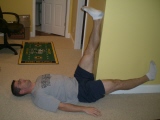
Once proficient at the supported SLR, then progress to unsupported and still using the arm press to lock in the trunk. You'll notice the athlete in this video just moved from supported to unsupported and struggles to get about 70 degrees of hamstring with the opposite fully extended. He can get approximately 85 degrees when supported on the wall. I want him to close the gap to under 10 degrees to address any lack of stability during running.
The last step then is unsupported without using the arm press to stabilize. Notice though that his trunk still remains rigid. A great test of core stability. This is my twist on the progression and is only done with an athlete who is nailing the prior exercise.
I'm not suggesting this is the only way to look at hamstring length. This is just my preferred method and have had good success with it working with athletes with hamstring strains, knee injuries, hip flexor strains, low back pain, etc. It's just one more way to look 'big picture'.