

Case Study using the SFMA/FMS on a Junior High athlete with Sever's Disease
Here is another case study utilizing the SFMA and FMS, this time involving a 14 yo. Male with Sever's Disease and a case of achille's tendinitis (on the Right) to go along with it. He actually had a similar problem last year on the Left which did resolve without physical therapy but it took over 3 months in a boot to do so.
This time around the athlete came to me 6 weeks post onset of symptoms. He rated his symptoms as a high of 8/10 when he had been running but now only high of 3/10 in the boot, and a low of 0/10. Much as it had last time, the patient's symptoms began during football season with the increase in running. No symptoms in the summer as he had not done much of anything in the offseason to prepare, and reported no symptoms last spring as a sprinter on the track team.
The only other history reported was occasional bilateral knee pain but none lately. The patient has no training history. No complicating medical history. The patient also plays basketball and does Tae Kwon Do.
Sever's Disease, also known as calcaneal apophysitis, is the most common cause of heel pain in the growing athlete and is due to overuse and repetitive microtrauma to the growth plates of the calcaneus. It occurs in children ages 7 to 15, with the majority of patients presenting between 10 and 12 years of age. Much like Osgood-Schlatters, Sever's is caused by increased shearing forces on the growth plate.
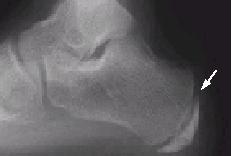
So here is how he presented on Day 1 using the SFMA:
Functional Non-Painful - Cervical and Shoulder ROM
Functional Painful - None
Dysfunctional Non-Painful - Multi-Segmental Flexion, MS Extension, MS Rotation, Deep Overhead Squat, and Single Leg Stance
Dysfunctional Painful - None
According to the strict letter of the law here, you really only need to breakout the dysfunctional non-painful patterns to determine the exact cause of the dysfunction. I will do that, but also tend to look at some other things consistently as well even though they may have cleared with my initial assessment. For example:
Seated edge of plinth - active/passive hip internal and external rotation, thoracic rotation, tibial internal and external rotation (if the knee is painful or MS rotation is limited).
Supine -- A/P hip flexion (feeling for lumbar flexion), FABER, terminal knee extension, ankle dorsiflexion, active/passive straight leg raise.
Sidelying - active hip abduction, strength testing and timing of TFL vs glute medius, ober test.
Prone -- active/passive hip extension, glute vs hamstring timing, active knee flexion (looking for lumbar extension), glute max strength test, active/passive hip internal and external rotation, prone press-up.
There are a few more that I really like but won't automatically get to those unless the pattern is out and on the table they don't look right. The Thomas test is one of those. If the MS Extension pattern is out, I'm doing it. If they looked good performing MS extension but in prone I see issues with hip extension range of motion/strength then I will perform the test.
Hope that makes sense. I just feel like there are so many compensations at our disposal that a second look is warranted. Gray had mentioned this as well in an interview on here last year, that he has had plenty of athletes that show with impairments on the FABER and Thomas tests but could still deep squat and demonstrate full excursion with standing mobility testing (i.e. MS extension and rotation). The fact was they were fighting through their impairments and using alternate movement strategies. It's these types of things unchecked over time that can ultimately result in an injury. And it's these same things that make chasing the symptoms a poor treatment strategy.
So back to the case study. Here are the impairments I found in each position:
Seated: Hip internal rotation 15 active/25 passive
Supine: FABER positive (stiff bilateral), ankle dorsiflexion 10 deg R/15 deg L, and ASLR to 50 degrees.
Sidelying: TFL dominant, hip abduction strength 4-/5 bilateral
Prone: Hip extension 10 deg active/20 passive bilateral, glute max strength 4/5, hip internal rotation 20 active/25 passive.
Other: Thomas test positive for TFL (stiff).
According to this SFMA, MS flexion was the one he struggled with the most, about 6 inches from his toes. MS extension and rotation were only slightly off. In single leg stance he pronates significantly and the femur internally rotates. During the squat he cannot get even halfway into it prior to heels off the floor, valgus collapse, and trunk coming forward.
Because MS flexion is his biggest issue, I broke that one out completely first. The patient was still unable to touch his toes seated with a sacral angle of about 70 degrees, about 4 inches off this time. As I mentioned earlier, ASLR to 50 deg active/passive 60 deg. Testing for lumbar, hip, knee flexion in supine and quadruped showed no limitations. The way this breaks down, I'm thinking he may have some core instability contributing to this as well as some tone in the hamstrings and calves.
Treatment 1
Local treatment consisted of massage stick to calf, peroneals, and anterior tibialis (showed him how to do this at home with a smaller rolling pin), followed by mobilization with movement to both ankles. The technique that worked well for him was a posterior talar glide. From there, I took him through 1/2 kneeling ankle dorsiflexion with the foot supinated. Check out the video below.
The patient demonstrates dorsiflexion of 17 deg on R, 20 deg on L following all this.
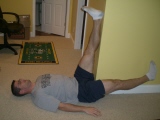
To address MS flexion, I chose to start with the active straight leg raise. Went back to Gray's leg lowering progression from Athletic Body in Balance so the first set he has one leg supported on the door frame while the other goes through flexion/extension. The patient is pressing down with his hands into the floor to engage the abdominals. By the time we are done with two sets he's right about 70 degrees with his ASLR supported.
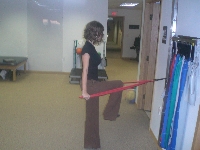
I also had him start working on single leg stance with core activation. With cuing to stay tall he was able to engage core and glutes which prevented the femoral internal rotation and cleared up much of the pronation. 10 second holds for 5 reps each side.
Finally, had him work on sidelying hip abduction with his head, shoulders, hips, and heels against the wall just to find get the feel for using the lateral hip. The patient was encouraged to press his top hand into the floor to engage the abdominals which did help lock up his trunk. The patient was only able to complete 2 sets of 10 prior to fatigue and breakdown of form.
I will admit that was a lot to cover on Day 1 but I had extra time (next patient canceled) so I took advantage of it. The patient was to work on all of these things at home twice daily.
Treatment 2
The patient returns 4 days later. Both ankles were mobilized again and followed up with massage stick work and 1/2 kneeling ankle dorsiflexion. The patient was able to actively dorsiflex to 20+ degrees bilateral on the table, and able to take his knee to the wall with the foot three inches away (subtalar neutral).
The patient is able to perform a supported ASLR of 70+ degrees with good core stabilization. He continues to use one set of the supported version as a warm-up, and then progresses to the unsupported version seen below. He is now 4 inches from his toes performing MS flexion.
Single leg stance with core activation looks great so added 1/4 turns: perpendicular to the band right and left, and facing away from the band. The patient continued with 10 second holds, 3 reps each direction. The patient is functional non-painful with single leg stance.
I also had time to take up his MS rotation deficit today. His lack of hip internal rotation was addressed with one of Mulligan's mobilization with movement techniques. Passively I can get 30-35 degrees easy. This was then followed by 1/2 kneeling trunk rotations - making sure patient takes up the slack in the hip flexor group and contracts the glutes to get a good stretch while working rotation. This also will not allow hip flexors/quad to take over stabilizing the core.
The patient clears MS rotation following the mobs and corrective exercise.
As far as the sidelying hip abduction, the patient can perform 20 reps now each leg for 2 sets. I discontinued this exercise as he is working the lateral hip area much more now in single leg stance as well as with the 1/2 kneeling trunk rotations.
We also started working on the squat progression using a core board (used a basketball at home). A little out of order here but it was something he really wanted to work on. Usually I would wait until all the other patterns had cleared, but was ok with it since it was non-painful.
Treatment 3
The patient returns 8 days from his initial visit. Reports he has no pain walking at home in bare feet, but still can have pain up to 3/10 while in the boot. The big difference between the two is that he comes down on his heel in the boot and lands much softer and more on his midfoot without the boot.
Warm-up consists of massage stick to lower leg, 1/2 kneeling ankle mobilization, SL stance with core activation in 4 directions, and the leg lowering progression.
The patient was just short on the hip turn with MS rotation so this was addressed again today. Hip internal rotation mobilization with movement were performed bilaterally followed by the 1/2 kneeling trunk rotations. Seated active IR to 30 deg/passive 35 deg; prone active IR to 30 deg/passive 40 degrees. MS rotation is Functional Non-Painful following treatment.
The patient was also Functional Non-Painful for MS extension. Can't fully explain that one other than he was close to start with, and from experience clearing rotational issues in the hips and/or t-spine can help to correct extension deficits as well.
Continued to work on the squat progression. Reduced the heel lift from 25lb plates under the heels to 10's.
Also started working on his run technique with the wall drill seen below. The beauty of this drill is it teaches kids to get on the ball of the foot with perfect posture and triple extension.
Treatment 4
It's been two weeks since his first treatment, and at this point the patient is reporting no achilles symptoms and only 1-2/10 pain in the heel if he comes down hard on it. The patient is able to demonstrate 20+ deg of dorsiflexion bilaterally, multi-segmental extension, rotation, and single leg stance are all functional non-painful. The patient's deep overhead squat remains dysfunctional and non-painful, but is significantly improved.
Warm-up consists of 1/2 kneeling ankle mobilization, SL stance with core activation in 4 directions, and the leg lowering progressions.
The 1/2 kneeling trunk rotations are progressed to walking lunges with trunk rotation over the back leg (internal rotation).
Squat progressions continue with 10 lb plates under the heels. The patient runs through the stretching as seen in the video x5, then performs 5 deep squats with arms overhead to finish the set.
Wall drills continue with static holds and then progressed to marching. The toe touch progression was added to work on the MS flexion pattern which remains his biggest issue. The patient's ASLR is between 60-65 degrees, but he is still about 4 inches off his toes. The patient is about an inch off his toes following the progression.
The FMS was also performed today since the patient is pain free with all therapy activities. Here are the results of the FMS:
3/3 - Hurdle Step, In-Line Lunge, Shoulder Mobility, and Trunk Stability Push-Up.
2/2 - Deep Overhead Squat, ASLR, and Rotary Stability.
The patient is already addressing the squat and ASLR patterns through PT and his home program so he's all set there. Out of time for the day so planned on addressing rotary stability at the next appointment.
Treatment 5
Unfortunately, treatment #5 never happened. The patient had a follow up appointment with the orthopod the same day and was cleared to participate in basketball. The patient would be allowed to play in the first game if he made it to enough practices so he would have to start today. The patient had been doing some running after our last session and obviously found that the more he stayed off his heels, the better he felt.
Follow up via phone a week later, the boy's father indicated that he was doing just fine and would be playing that night. The boy was continuing with his home program on a daily basis, and staying off the heels as much as possible when running.
The interesting thing about this case was how quickly things changed in regards to mobility and quality movement. I would estimate his FMS score to be a 14/21 at best on day 1, and it improved to an 18/21 by the last session two weeks later! Obviously the tissue quality in most younger athletes is going to be much better than that of adults. On top of that they're not quite so far removed from the days when their movements were much more efficient and without compensations. As with the case study on the snow boarder I did a few weeks ago, using a system like the SFMA can result in a quick return to sport.
With more time, I would have liked to address his rotary stability further, and he could begin to strengthen those patterns he had become successful with. I'll be seeing him again this coming summer as he gets ready for football so it will be interesting to see where he is with his functional movement at that point.
Final Program