

Teleseminar Interview #5 - Mike Reinold

Dr. Michael M. Reinold, PT, DPT, SCS, ATC, CSCS
Mike is considered a leader in the field of sports medicine and orthopedic rehabilitation. As a physical therapist, athletic trainer, and certified strength and conditioning specialist, Michael specializes in all aspects of care of shoulder, elbow, and knee disorders. He has worked extensively with a variety of professional athletes with emphasis on the care of throwing injuries in baseball players. In addition to his clinical work, he has made significant academic contributions in the form of laboratory research, biomechanical research, and clinical outcome studies.
Michael is currently the Assistant Director of Medical Services & Head Athletic Trainer of the 2007 WORLD SERIES CHAMPION Boston Red Sox Baseball Club. He is also the Coordinator of Rehabilitation Research and Education of the Department of Orthopedic Surgery, Sports Medicine Division, of Massachusetts General Hospital at the MGH Sports Center in Boston, MA. In addition, Michael is Adjunct Faculty at Northeastern University in the Doctorate of Physical Therapy program. Michael was formerly the Facility Director of Champion Sports Medicine and the Coordinator of Rehabilitative Research & Clinical Education at the American Sports Medicine Institute in Birmingham, AL.
Be sure to check out Mike's blog at MikeReinold.com
This post came about from some of the live Q&A that we had following my webinar last week on "assessing asymmetry in the overhead athlete -- does asymmetry mean pathology?" (the webinar is now recorded and available for download if you couldn't make the live session). We discussed some asymmetries with the scapula and talked about stretching the pectoralis minor. I thought this would be a good topic to post on for everyone to discuss.
The Best Stretch for the Pectoralis Minor?
As our knowledge has increased of the importance of posture and scapular position in normal shoulder function, the need to adequately lengthen the pectoralis minor becomes apparent. Any restrictions in pec minor length will pull the scapula into a protracted and anterior tilted position, which has been shown to inhibit strength of the lower trapezius and decrease the width of the subacromial space.
A problem exists, however. Many, if not all, of the standard stretches for the pectoralis minor place a decent amount of strain on the anterior capsule. This is typically something that many patient populations would want to avoid. We discussed some stretches for the pec minor in the past, but I wanted to talk about this again now that a year has past.
What does the evidence show?
There is some evidence behind stretching. A study by Borstad in JSES in 2006 compared three different techniques of stretching and found that they all produced changes in muscle length, but that the doorway stretch was superior:
1. The doorway stretch = +2.24 cm 2. A manual stretch in the sitting position = +0.77 cm 3. A supine manual stretch = +1.7 cm
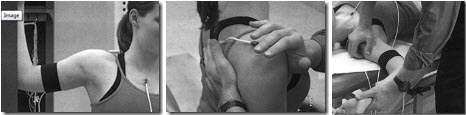
While the doorway stretch may have been superior, it has hard to coach and even more difficult to monitor when the person goes home and starts torquing on their shoulder. This is a good exercise for some with adhesive capsulitis but I tend to avoid it in most patients that need pec minor stretching only. I like the sitting stretch, I think it may be worth trying. But I think we can improve on their supine manual stretch. The arm should be in a different position and I believe that proximal hand position is to far over the anterior aspect of the shoulder and not on the coracoid and pec minor.
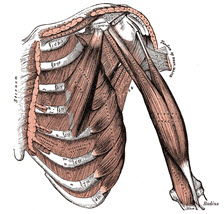
If you look at the fibers of the pec minor, you'll see that the muscle is orientated in a fashion that require a greater amount of elevation. Just like any other stretch it is important to align the joint according to the position and orientation of the muscle origin and insertion.
Not a bad start in terms of efficacy but I wish there were more stretches involved in the study.
Home Stretch for the Pectoralis Minor
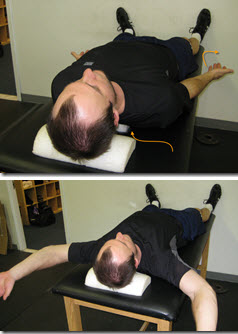
So what do I do for patients at home if I don't like the doorway stretch? Considering this is likely a postural adaptation, I would like to see more of a low load long duration stretch of the joint. I tend to do this mostly supine with a half foam roll, though a towel roll could substitute. You can do this two ways, first by just laying supine with the foam roll between your shoulder blades and allowing your shoulders to drop back and externally rotate. The key is to relax in this position for a prolonged duration. Secondly, I would add a more specific stretch to the pec minor by elevating the arms and repeating the hold. I find these stretches to be safer and potentially as effective as a doorway stretch.
Another thing worth mentioning is the thoracic pivot, which is a great tool that is even better than the half foam roll. It is more comfortable and a more specific curve to meet your thoracic spine. I use one and love it. The draw back is that it is more expensive that a foam roll. But I also have the cervical pivots and use them all the time on patients and myself to work on posture and reduce tension headaches, shoulder pain, and scapular dyskinesis.
Manual Stretching the Pectoralis Minor
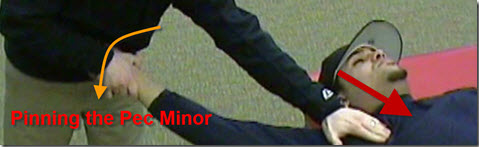
I think we can do better using manual stretching in addition to the postural exercises I recommend above for at home. To stretch the pec minor, I have settled on a manual supine technique the combines aligning the shoulder in the correction orientation of the pectoralis minor muscle fibers and stabilizing the muscle by the coracoid. Notice I said stabilizing the muscle. I place a broad four finger grip deep into the pec minor just off from the coracoid. But it is important to note that I do this with the arm/pec in a loose position. You need to think of it as stabilizing, or "pinning" as I call it, the pec minor down. What you'll find is that you will obtain a stretch in the pec (not the anterior shoulder) and you wont be able to bring the arm far down past the plane of the table.
Pin the muscle down with the arm loose:
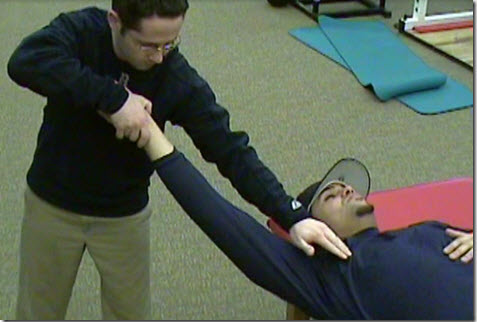
And then bring the arm down:

Notice in these two photos below that by just adding this "pinning" of the pec minor I completely change stretch and take the strain of the anterior shoulder. In this position it is also pretty easy to utilize some MET and ART techniques as well, both of which I have found effective. The perspective is a bit hard to tell from the angle, but note that on the pinning stretch, the arm is about even with the table (perpendicular to the ground) to just barely past the table, without the pinning it dips about 20 degrees past the table:

You'll know if you are doing this stretch right but asking the person what they feel -- nice stretch in the pec versus a stretch in anterior shoulder. Sometimes they'll even experience a tingle down their arm or in their hand, which is an obvious sign you are stretching too much of the anterior shoulder. I should also mention, it takes 2-3 sessions for the patient to get used to this stretch as you finger tips in this area are not always comfortable. Resist the urge to broaden you contact spot and use the palm of your hand etc, it never works as well.
Borstad, J., & Ludewig, P. (2006). Comparison of three stretches for the pectoralis minor muscle Journal of Shoulder and Elbow Surgery, 15 (3), 324-330 DOI: 10.1016/j.jse.2005.08.011