

Teleseminar Interview #7 - Dan John
Dan John is a one of a kind strength coach with a wealth of experience in the trenches as a coach, a competitive lifter, and still a competitive thrower. Dan will talk about his basic philosophy of strength and conditioning, how his warm-ups are definitely not 'traditional', if something is important why you should do it everyday, the genius of the goblet squat and Turkish Get-Up, his book "Never Let Go", and lots more. Dan is an great speaker so get ready to be entertained and educated.
To download this interview, click HERE
Bio
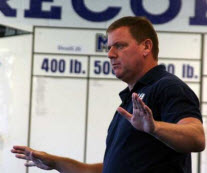
Dan John picked up a barbell for the first time in about 1966 when his brothers bought a set from a local department store. It was the first time the world made sense to him and he has been lifting and throwing things since that day. And he thought he knew it all until he ventured out to the RKC training in San Jose. Newly humbled, he has begun a new journey of learning and lifting. Recently, Pavel Tsatsouline promoted Dan to the rank of Senior RKC Instructor.
Dan John has been teaching and coaching for well over thirty years. He is the former Strength Coach and Head Track and Field Coach at Juan Diego Catholic High School in Draper, Utah. He remains a full-time on-line religious studies instructor for Columbia College of Missouri and contributing writer to Men's Health.
Dan has Masters degrees in history and in religious education, as well as intensive work at the American University in Cairo, University of Haifa, and Cornell. Dan has written articles for "Catechetical Update" and "Utah Historical Quarterly", as well as being a columnist for the "Intermountain Catholic". Dan was also a Fulbright Scholar in 1985. In addition, Dan writes articles for a variety of strength magazines and publishes a little newsletter called "Get Up", which registers up to a quarter of a million hits a month. You can also read his work at DragonDoor.com and T-Muscle.com, and magazines like "Men's Health" and "Outside", and his busy forum at DaveDraper.com . If you sneak over the border into Utah and want to work out, give him a shout.

________________________________________________________________________________
Here are a few great videos from Dan, including a few from his DVD set.
This video from Mike Boyle demonstrates Dan's Goblet Squat + Pressout. This is one of the better corrections I've found for someone who has the mobility to deep squat but not the stability.
Working the bottom of the Get-Up
For more great information on Dan, visit DanJohn.net. There are tons of free articles, videos, and strength training philosophy for free. Its a great site so be sure to take advantage.
______________________________________________________________________________
by Dan John
"I see you had Grape-Nuts for breakfast."
"Sorry, Mr. John."
That short exchange between a coach and athlete may seem strange, but when it is written in the young man's Yale University application, it seems perhaps stranger. Yet, that is the key moment in Ted Vogt's letter for admission. He recounted how no one believed that he could lose fifty pounds of fat, no one believed he could become Student Body President, and, finally, no one believed he could get into Yale.
He achieved all three goals. He gave me a copy of his admission letter. To be honest, I was astounded. Rather than focusing on "how wonderful I am," Ted highlighted one of the worst experiences of his life: the "Big Al Challenge." As a football coach, I believed that there had to be a final task to wind up the conditioning work of summer before putting on the pads for double sessions. After my dad died, "Big Al," I dedicated this task in his memory. For the record, my dad was maybe five foot seven and never in his life weighed over 130 pounds. But, he was a fierce boxer, a fine shortstop, and proudly set forth five sons who competed in Division One athletics. (There goes the genetics argument.)
The challenge was simple: one lap around the football field, seven sets of stadium steps, flop down and do seven sit-ups. Seven times. Almost two miles of running, 49 stadium steps and 49 sit-ups, yet the killer was coming back up after the sit-ups. For most of the athletes, it was a challenge against time. For Ted, it was a challenge against himself. He noted in his essay: "All those axioms you hear like: 'A winner never quits and a quitter never wins,' suddenly made sense. It was just me and Big Al." He finished long after everyone else went in. Then, he puked on my shoes.
The lesson Ted learned is the single greatest lesson an athlete and lifter can ever learn: sometime, somewhere, somehow, you have to toss out science, toss out periodization, toss out logic, and do something that extends you far beyond what you think you can do. One of the great joys of being a parent is to discover that you can go for a week or two without truly sleeping as you care for a sick child, yet continue to work, commute, shop, and survive. Certainly, it is an act of love, but you retain the understanding that "if I have to" I can survive without eight hours of perfect sleep.
In high school, my friends Claude, Jack, Greg and I would buy football shoes together a few weeks before the start of double sessions. To break them in, we would jog around the high school field twenty times. Our feet would bleed, our skin would burn, and, to be honest, there was no carryover to the game. Yet, it taught us to keep going, keep moving. Throughout my adult life, I retain those lessons of success: 1. Show Up 2. Don't Quit 3. Ask Questions Later.
Throughout my life, I have occasionally "raised the bar" for no real good reason. My junior year in college, I decided to see if I could squat bodyweight, Olympic squat style, fifty times. Why? I don't remember but I kept thinking around rep thirty there had to be a good reason. From forty to fifty, I breathed up to ten times per rep, fighting off back spasms and brain fog. I entered a Triathalon once, too, just to see what would happen. After nearly drowning, I crashed then staggered for ten kilometers. But, I finished.
In the past year, inspired by Brooks' insights about Kim Woods "100 Singles" training, a group of us centered at the Old School Training Site on the internet have met on-line in a friendly competition. Simply, find a lift, throw, or challenge and do it 100 times. Not in a row… no, no, no. Rather, it should be something that can be done once, rest, repeat.
I have seen a lot of criticisms of it. You will get hurt. I do. You will ruin your training. It does. It sounds stupid/It sounds unsystematic. Absolutely. What the critics don't understand is that every rep from twenty on is an effort of the spirit. Ted would understand.
For the last challenge, I erred in several ways. First, I chose Squat Snatches. In addition to its technical aspects of simply doing a snatch, I needed to overhead squat 100 reps. Second, I chose to do it with 165 pounds. I have this idea that I should keep myself in the condition I was as a Junior College athlete. In my first Olympic Lifting meet, I opened with 165 pounds, therefore…
The gym was too hot and too windy, hovering in the high eighties already by nine in the morning. My first twenty five singles, without a miss, finished in 27 minutes. Not bad. I did them "cluster" style, basically a set of five singles. Do a rep, rest a few seconds, rep, rest, rep… for five. Then, sit down and read for a few minutes. In one hour, basically "on time," I finished fifty reps, then I hit the wall. After seventy reps, I began to cluster in threes and twos. Soon, the cluster was one rep, stagger over and sit down. I monitored my water consumption, three 52 ounce mugs of water for the 100 reps. I added two pounds of bodyweight from start to finish, 220 to 222. The next day, I would weigh 216, the following 214. As the reps near 100, it isn't lifting anymore, it is the summit of Mount Everest. Most people die on the way down.
So, how do you train for the challenge that took me two hours and twelve minutes? The short answer is that you can't train for the 100 rep challenge. It is like those high school teachers that hand their students an egg for a week and everyone pretends it is like raising a child. Knowing where you left your egg is not exactly the same as caring for a newborn. Doing twenty singles is a great workout, but it doesn't mimic the stress of knowing you are "one-fifth the way there." Yet, there are some things I would recommend. First, build up a stable of classic lifts. Certainly, the deadlift and the squat are appropriate for the challenge (I wouldn't recommend the bench for safety reasons, unless you have a very faithful spotter), but imagine the possibilities of clean and press, snatch, clean and jerk, one arm variations and a myriad of stone, balls and odd objects. Even if you decide on deadlifts, the other lifts will support your deadlift challenge. Second, set a date and prepare. You will need uninterrupted time, equipment in good working order, a place to sit and recover, water, perhaps some food, something to read and some method to record. I wouldn't trust your memory. I note the clusters of five in my training journal when I sat down and noted anything of importance. The mental gymnastics of keeping tabs of how many finished, how many to go, what percent done, what fraction done and all the other tricks of maintaining sanity vanish when it every single seems like a maximum attempt.
What can you expect from a challenge like this? Hands like claws for a few days, additional blood blisters, probably some structural damage to something in your gym, and most important, you can expect a good story. In the weeks and months to come, you will discover a new reservoir of strength in your life and lifting. A typical quality workout like ten singles or three sets of three will be "a tenth" of what I can do. It is refreshing and life changing.
Ask Ted.