

Introducing Postural Restoration™ to the Sports Clinician
Zach Nott, CSCS, SCCC, PRT [email protected] Julie Blandin, PT, ATC, CSCS, PRC [email protected]
The Postural Restoration Institute® offers advanced continuing education for the healthcare professional, athletic trainer, and strength coach. It is the goal of this article to introduce and educate the sports rehab expert on a few Postural Restoration (PRI)™ concepts and offer suggestions on how to recognize certain PRI™ patterns a client may display.
To understand Postural Restoration™ you have to be able to recognize how the science of asymmetry and the science of respiration affect movement and posture.
The Science of Asymmetry
The PRI™ thought process is based on anatomical asymmetry and asymmetrical patterns of muscle pull that develop due to postural habits, repetitive movements, and side dominance. Everyone is dominant on one side of their body or the other. This dominance is often exaggerated by the jobs we do or the sports we play. We never use our bodies equally on each side. This theory can often explain how a person develops an insidious onset of pain only on one side or why a joint on one side wears out before the other.
PRI™ takes this a step further and recognizes human function is based off of an integration of systems that are also asymmetrical. Our neurology, respiratory, circulatory, and vision systems are not the same on the left side of the body as they are on the right. Our brain, primitive reflexes, and vagal system are not the same either. Each side has a different responsibility, function, position, or demand put on them. The challenge exists in understanding and appreciating how movement patterns are influenced by this internal asymmetry and on how one side of the body may indirectly influence the position or movement on the opposite side of the body.
With Postural Restoration™, we recognize these fundamental asymmetries in the body, and attempt to get our clients and patients into a state of "neutrality". Neutrality is our way of communicating about balance and reciprocal function for a human body we know will never be truly symmetrical. To define this state of neutrality we use objective tests and measures. The state of neutrality helps us communicate about tone, muscle balance, and improved joint position. Most importantly, neutrality objectively gives us a way to determine when there is neuromotor balance between the right and left sides of the body.
Our fundamental asymmetries become a problem when we can no longer work with them and become a slave to our own design. Because of our internal asymmetries and because we function differently on our right than we do on our left, we have a tendency to become locked into certain and predictable Biomechanical Adaptation Patterns (BAPs). People get locked into these patterns at varying degrees. The more locked up they are, the more compensatory movement strategies and difficulty resting may be seen. BAPs are predictable because our design sets us up to be right side dominant (regardless of handedness). We tend to stand on our right leg more than our left. We run around a track in a counter-clockwise motion. We all drive with our right leg and reach for things with our right hand. PRI™ teaches you how to evaluate for BAPs and how the position of one side of the body compares to the other. This is important because we are always in a different position on either side of the body. How we function in that position is something that interests us for evaluation and treatment. A glute medius on the left is mechanically positioned to work differently for single leg support than the glute medius on the right. A right tricep and right lower trap have to work a lot harder to position a scapula on a ribcage than on the left. The abdominal wall on the left side often fires insufficiently or delayed because of its position compared to the right.
A PRI™ trained therapist, or athletic trainer, or strength coach will look at the right side of the body differently than they look at the left. There are different circumstances at play depending on the side in question. Evaluation and treatment of an impingement in the right shoulder is done in a different manner than an impingement in the left shoulder. Patellar tendonitis often is treated differently depending on which knee is symptomatic. Right piriformis syndrome is looked at very differently than left piriformis syndrome. It is the goal of the Postural Restoration Institute® to create an understanding of these asymmetries and how to manage them in order to restore reciprocal function.
The science of respiration
Our very first action when we are born, and our last action before we die, is to inhale. Our body will sacrifice almost everything else to allow us to continue to breathe. The diaphragm is one of the most important muscles in our bodies. As movement and muscles experts we should be able to evaluate this muscle, just as we do any other. Postural Restoration™ teaches us how to evaluate the diaphragm and its influence on posture and gait. A mechanically disadvantaged diaphragm can lead to a host of problems, not only in the thoracic region, but also through the pelvis and down the chain, as well as up the chain into the shoulder complex and even the temporomandibular joint.
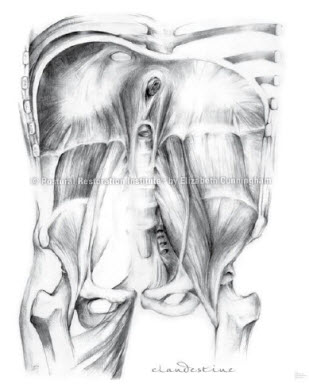
The diaphragm is a very large powerful muscle that attaches to our ribcage and spine. The diaphragm is instrumental in holding our core and axial skeleton in place. Because of the diaphragm and its influence it has on the spine and in rotational stabilization, PRI™ utilizes specific breathing techniques and neuromuscular exercises to help balance asymmetries found throughout our axial skeleton. Our diaphragm can basically be thought of as two separate muscles; one on the right, and one on the left. Our right diaphragm is larger, thicker, and stronger than the left. Because of the liver, it has an advantaged position to help it maintain its dome better than the left. We are designed to use our right diaphragm as a primary muscle of respiration. Our diaphragm on the left does not have the same structural support. It is smaller and the presence of the heart above it also allows for the left diaphragm to flatten and lose its ability to function as a muscle of respiration. You can see in this illustration how this would create an asymmetrical pull on the lumbar spinal segments
In order to gain a better understanding of the BAPs that develop, we encourage you to start looking for some common predictable findings that correlate with a left diaphragm that is not being used correctly for respiration. This includes noticing an asymmetrical infrasternal angle and left anterior rib flare. The asymmetrical pull the diaphragm has on the spine will alter the resting position of the axial skeleton. You will also see a right scapula that is more anterior tipped and internally rotated more than the left. A right shoulder lower than the left. Rib mechanics can be palpably restricted during exhalation on the left, and it will be harder to inhale into the right side without arching your back or using your neck. Shoulder mechanics will be altered, and you will see internal rotation restricted more on the right and horizontal abduction restricted on the left. These are just some of the postural and movement compensations we see.
We hope this article provides an adequate introduction to the Postural Restoration Institute® and some of its concepts. Please keep in mind that this is only a brief introduction, and in an effort to keep this article brief, a lot of topics and concepts were left out. We understand there are a lot of questions about PRI™ that may need to be answered in the future. In the meantime, please visit PosturalRestoration.com
 del.icio.us
 Digg
 Reddit
 Facebook
 StumbleUpon
 GoogleBookmark
 Technorati
 Furl