

Should We Train the Rectus Abdominus?
Mike Robertson
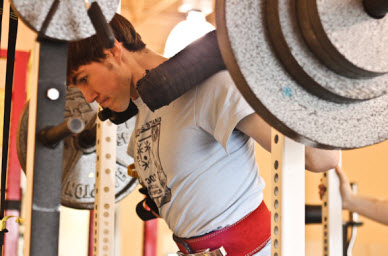
My goal today is simple: To blow your minds.
I have two basic things we're going to focus on today:
Yes, I realize it's hard to blow your minds if you don't read the post, so please! Bear with me on this one. I promise the end result will change the way you look at core and upper back training.
Chest Up? Ribs Down? Or Both?
When I was just getting started in the industry, I was obsessed with keeping the chest up.
Squats, deadlifts, RDL's, good mornings, you name it, and the cue "chest up" would improve it.
If you watch most people move, they have a tendency to collapse and lose their lumbar curve in an effort to get more range of motion.
Unfortunately, that increased range of motion comes at the spine, versus the hips, which is definitely not a good thing.
Over the years, though, we see more and more clients and athletes that come in who are locked in lumbar extension. And not just in their lower back, but in their thoraco-lumbar junction.
The "Ribs Down" Cue
One of the cues we've been using more and more frequently at IFAST is "ribs down." This may sound tricky, but we actually want the chest up and out (thoracic extension), but we want the lower portion of your rib cage to stay flat.
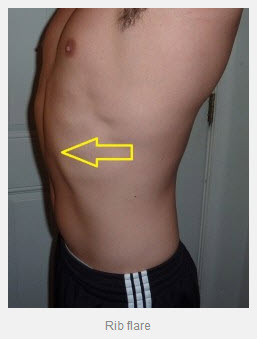
If your lower ribs are sticking out like this, it's called rib flare, and it's not a good thing.
If you've picked up a copy of my Complete Core Fitness webinar series, you already know that two of the most important components of core stability are proper function of the diaphragm, coupled with proper alignment of the rib cage and pelvis.
For starters, if you can't take a quality belly breath and expand your midsection forward, laterally, and even backwards, you've got work to do. The diaphragm is the ignition for proper core stability.
Furthermore, we need proper alignment between the ribcage and pelvis to properly engage not only the inner, deep core muscles but the bigger, stronger outer core muscles to boot.
What we're used to seeing is this combination of lower rib flare, coupled with an anteriorly tilted pelvis, which Charlie Weingroff calls a "scissored" posture.
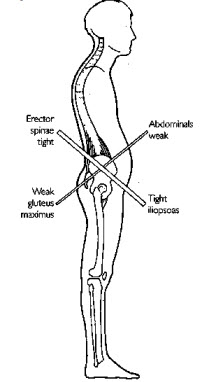
along with lengthening and weakness of the:
(Need a primer on all this geeky stuff? Read my free T-Nation article, Hips Don't Lie.)
We've done a great job of addressing the lower part of the equation. Rebuilding someone's stabilization patterns via tall- and half-kneeling exercises has allowed us to gain control of our pelvis, which is awesome!
The missing ingredient
But we're still missing an integral part of the equation: Alignment and control of our rib cage.
So how do we do that?
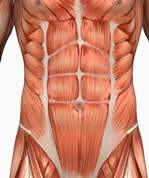
See, this is where I need to call myself out. I've been bad over the years of vilifying a muscle (or muscles) without looking at the big picture.
If anything, I've learned in my time that every single muscle has an important role in movement. The key is figuring out what that role is and learning how to effectively train it.
Now keep in mind, it's not just the rectus abdominis we're training, and it's not using the motions that most would assume (crunches, sit-ups, etc.)
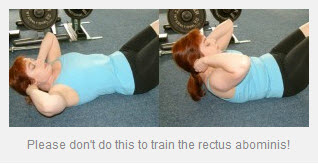
Instead, we need to train our rectus abdominis and external obliques to contract isometrically to resist extension of the thoraco-lumbar region.
We need to teach our upper abs to control our rib position so that we can maintain optimal alignment of the rib cage during exercise and daily life.
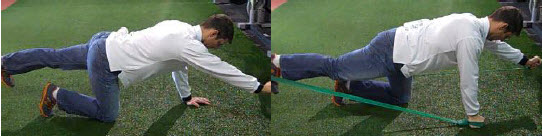
This all came together for me a few weeks back while reading Dean Somerset's blog. Well, it wasn't so much the blog post that did it, but trying the exercise started to put the pieces of the puzzle together for me.
Here's the post I'm talking about, along with a video of the exercise I've been working on:
If you're not at the gym, though, try this.
Wherever you are sitting, scoot to the edge of your chair and stick your chest out.
Keep in mind, I don't care if you do it wrong -- in fact, doing it wrong now will help you better understand where I'm going with all this.
So for now, stick your chest out by extending your lower back.
Now feel your lower rib cage. Chances are if you're hyper-extending the back, you're going to feel your lower ribs have become prominent.
Using your hands as a guide, try to keep your chest up but now drive your ribs DOWN. When you do this, you should feel a change in your mid-back.
Instead of feeling the extension/compression in your lower back, now you feel it in your mid back. And it's not longer a compression, so much as it is a muscular tension.
Do you know what we just did?
We just turned on your lower traps!
Closed-Chain Lower Trap Function?
I started thinking about this a few years back while attending a DNS seminar. Pavel Kolar was talking about how important the lower traps are, but said that all the open-chain training we were doing wasn't the best option.
In open-chain, the lower traps do a handful of things, including:
But think about the closed-chain function of the lower traps. Instead of moving the scapulae, what if they are there to help extend the thoracic spine???
This is where all this stuff starts to come together.
I think as we've progressed along the way, we get so focused on one spinal segment that we forget about what's going on at the others.
Keeping us in a neutral lumbar position immediately improved our outcomes working with clients and athletes who suffered from lower back pain.
Next, we started looking at the neck. We learned that if you can squat and deadlift with a more neutral, packed neck, you get the lumbar spine out of hyper-lordosis and increase neural drive to the glutes and hamstrings.
But the thoracic spine tends to get lost in the mix.
And this is a huge mistake.
Think about it in a different fashion. We choose exercises like push-ups and inverted rows because they tie together or unify our upper and lower bodies.
The thoracic spine is quite similar in that regard. We get so caught up and focused on neck and lower back position (the areas where most people feel or perceive "pain") that we forget about the thoracic spine, the area that unifies those two portions of our spine!
Coming Back to Neutral Spine
It's easy, but that's why simply using a PVC pipe to coach neutral spine on our exercises is so powerful. We don't coach one section of the spine at the expense of others.
(Here's a video about neutral spine:)
If you're using a PVC pipe or broomstick, every section of the spine has to be in a more ideal alignment.
Regardless of whether you're coaching an RDL, good morning, squat or deadlift, start using the PVC pipe to get an idea of where people's spines are in space.
If they have three points of contact, take it a step further. Ask yourself these two questions:
1. Can you slide your fingertips in between their lower back and the pipe, up to approximately knuckle height? If so, their lordosis is good. 2. Can you feel a bony prominence at their lower ribs? If not, then their thoracic spine is in an ideal position.
Summary and Actionable Item
I'm going to do a video post about this soon, but for now, focus on getting true thoracic spine extension while keeping your rib cage down in the gym.
Whether you're rowing, face pulling, RDL'ing, squatting, deadlifting, whatever -- keep that T-spine extended and work to control your thoraco-lumbar region.
Chances are you're not only going to feel stronger and more stable, but you're going to be stronger and more powerful over the long haul as well.
______________________________
For more great articles from Mike, be sure to check out his blog or sign up for his newsletter HERE
Be sure to check out the link for Complete Core Fitness. I've seen Mike present on this twice now, and have to say he does a great job breaking down his system in a way that will make it easy for you to implement right away. Can't go wrong with any of Mike's projects so just wanted to share that with you.
BIO

Mike Robertson is the co-owner of Indianapolis Fitness and Sports Training and the President of Robertson Training Systems in Indianapolis, Indiana. Mike has made a name for himself as one of the premier performance coaches in the world, helping clients and athletes from all walks of life achieve their physique and sports performance goals.
Mike received his Masters degree in Sports Biomechanics at Ball State University. His graduate assistantship was performed in the Biomechanics Lab, a division of the Human Performance Lab. In his time there, Mike was responsible for setting up a complete online exercise database, assisting in research on strength and power development, and also played an integral role in starting up the strength diagnosis clinic. Working in the athletic weight room is where Mike found his calling, however, and he put in nearly 1400 volunteer hours as an assistant strength and conditioning coach in 2 years time. Mike worked primarily with the football, volleyball and soccer teams, while counseling and coaching individual athletes from all of Ball State's 26 varsity sports.
Finally, Mike is an accomplished athlete and coach in the sport of powerlifting, having totaled 1400 pounds in the 198 pound weight class. Mike has coached several National champions in the Collegiate ranks, and as an assistant coach for the 2004 USA World Bench Press Team, Mike helped the team clinch a second and first place finish for the Men's and Women's teams, respectively.
 del.icio.us
 Digg
 Reddit
 Facebook
 StumbleUpon
 GoogleBookmark
 Technorati
 Furl