

Got Disc?: A Structural and Functional Perspective on Lumbar Disc Injury Diagnosis and Management Part I
Dr. Phillip Snell
Can you recognize a disc patient when they walk into your office? The reason I ask is because a sizable number of the chiro students that come through my office find it difficult. The MDs that I see in the office don't seem to know it when they see it…or even when they have it! It was also enlightening a year ago while working with Dr. Craig Liebenson to see the DC/PT crowd in the 80+ audience struggle with a disc presentation.
I've wondered about why this seems to be obtuse to many clinicians and I think that it is ironically due at least in part, to the way we ingest the literature regarding back pain. An artifact of the RCTs on back pain is that clinicians are trained to diagnose disc injury only in the presence of frank neurological signs. After all MRIs frequently demonstrate disc pathology in the asymptomatic population and that's the only way we can be sure the disc is injured, right? Recently, one of the world's best known, and most published spine researchers was rumored to have said (paraphrasing) "Randomized Controlled Trials (RCTs) on back pain should be banned because they're so f@#$ed up"'. What on earth did this researcher mean? RCTs are the gold standard of evidence-based practice! In the post-modern, evidence-based world, shouldn't we be on bended knee to the "evidence"? As a clinician who has taken part in some of those major clinical trials I would say yes…but…
Let's review the definition of evidence based practice as defined by Joel Sackett. It is defined as practice based on the following 3 components:
1. The best available current scientific evidence. 2. The clinical expertise of the provider. 3. Patient choice in their care.
Here is a quote from Sackett that I think is germane to this blogpost and speaks directly to the 3rd point above and to the insecurities of many who are afraid of EBP:
RCTs are limited by the questions they ask and by the populations they ask them of.
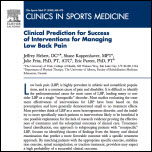
For instance, some cynically note that specific exercise has not been shown to be beneficial for back pain. The problem is that historically, the cohort in LBP studies has mostly been heterogeneous and doesn't account for either what type of exercise is prescribed, or what type of subgroup of back pain is receiving the prescription. Jeff Hebert et al, described these subgroups nicely along with effective treatment modalities for the subgroups in this paper.
I feel another misinterpretation of the literature is regarding the diagnosis of disc injury and radicular presentation (sciatica). Many clinicians are trained to only make the diagnosis of disc injury if neurological symptoms are present (numbness, tingling, pain, motor weakness in a dermatomal distribution). It used to be that we'd rely on MRI to make the diagnosis but now know that many asymptomatic people have disc pathology on MRI. However, a functional approach takes account for a continuum of an injury. I feel that only calling a disc injury a disc injury when one has neurological signs and symptoms is like ignoring the smell of smoke before the fire over takes you. I also feel that failure to identify disc injury prior to neurological deficit has a major effect on the public health and on cost of health care. Reflecting back to point 2 above, the clinical expertise of the provider, I'd like to take an opportunity to describe how I address disc patients now after treating them daily in clinical practice for 10 years.
So how do we detect a disc injury before it causes neurological signs? By assimilating multiple clues from the patient's history, physical exam and neuro exam as well as any imaging findings.
History
Family history is very important here as Videman and Battie's research suggests that a genetic component is at play here, and seems to involve some polymorphisms that result in weaker collagen formation and subsequent disc degeneration (may account for 30-70%!). Also important are the activities of daily living that worsen pain. The hallmarks that I've seen are:
This video shows a quick correction of these movement patterns so that a disc patient can quickly be taught how to stop hurting themselves. It is part of the free educational video area of FixYourOwnBack.com.
Examination
In the functional rehab world, it is currently fashionable to poo-poo structural issues in diagnosis and management of patients. My opinion is that this represents an adolescent trend in healthcare. We have errantly over-relied on structural cause for pain and dysfunction for far too long. While the research of folks like Ron Melzack, Lorrimer Moseley and David Butler has rightly brought our attention to the 'Neuromatrix of Pain', I fear that we may be throwing the baby out with the bath as we rush to disregard structural pathology. In an interview I did with Michael Adams, he had the following quote re: research on disc injury:
"Most people producing the research concerning back pain don't talk about disk injury. It's almost a shock to find someone take a breath and actually talk about disc injury."
To bring the discussion back to the exam of the back pain patient, the current evidence suggests a cluster of orthopedic tests is best to help identify lumbar disc injury and whether or not that disc injury compromises a nerve root. Below is a video I did putting these 2 tests together in the way that I perform them in clinic for expediency and accuracy. Additionally, I add a functional test for lumbar extension borrowed from the McKenzie folks to help identify quickly how to treat the patient both in the clinic and with home exercise.
Quick overview of the 3 tests :
In the next post, I'll lay out a functional approach to disc injury management that highlights inclusion of functional tests and exercises below:

___________________________________________
BIO

 del.icio.us
 Digg
 Reddit
 Facebook
 StumbleUpon
 GoogleBookmark
 Technorati
 Furl