

Case Study - Professional Dancer with Low Back Pain
Joe Heiler PT, CSCS
The patient in this case is a 33 yo F 'retired' professional dancer with complaints of bilateral low back pain. Pt is still teaching dance full-time and competing in a local 'Dancing with the Stars' type competition. The patient has a history of another back injury in high school while high jumping (pars fx), and then again while majoring in dance in 2001 (unsure of exact injury). The low back continued to be painful for a number of years while performing so she retired in 07'. She has felt better since then but now that she is competing again she is starting to have the same problems.
Other Relevant Hx:
The patient does not want to have to stop her dancing so the goal is to get her through the competition and hopefully decrease her symptoms at the same time.
Day 1 Presentation:
SFMA
DN - c. spine flexion, c. flex/rot, all shoulder (Lumbar Spine ext. to compensate), MS flexion (flat LS and excessive mobility), MS Rotation B (mobility R > L), DOS, SL stance L (pelvis not level) FN - SL stance R DP - MS Extension (very limited, immediately hinges LS before hips move and immediately painful)
Breakouts
Cervical - FN active supine c. flex/rot B, DN flexion active/passive Shoulders - DP prone active/passive LRF, FN MRE prone MS Rotation - t-spine ext/rot. FN active, seated hip internal rotation FN R, DN L (A and P); seated hip ER DN B (A and P) MS flexion - ASLR and hips FN mobility and stability, prone rocking - DN for lumbar flexion mobility
PRI
Adduction Drop Test (+) B, Thomas test (-) B, Toe Touch (-), full deep squat = PEC patterned
Day 1 Interventions:
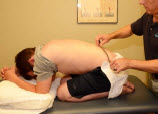
SFMA changes - MS flexion still lacking lumbar flexion, MS extension DP but significant increase in quantity and quality of movement (pain only at end range). MS rotation improved quantity B to FN to R but still DN to L.
Day 2 Presentation:
Three days later pt reports 50% reduction in back pain intensity when present, frequency 75% reduced.
SFMA - MS rotation R is FN, MS rotation L remains DN; MS extension DP at end range but continues to be much improved (good hip extension now).
PRI - (-) Add. drop test B, (+) PADT (Pelvic Ascension Drop Test - basically an active Add. drop test that demonstrates frontal plane control of pelvis and hips).
Day 2 Interventions:
Post treatment SFMA - MS rotation FN R, clears to the L but with effort so remains DN
Post treatment PRI - (-) PADT - essentially she can perform the Add. Drop test independently maintaining good pelvic control. Hruska Add. Lift Test = 3/5 B
Day 3 Presentation:
One week later reports back pain intensity when present 1-2/10, frequency <5% of the day - can eliminate back pain with exercises.
SFMA - MS rotation R is FN, MS rotation L remains DN on L; MS extension DN now; B shoulder MRE is FN, B shoulder LRF still DN (minor LS extension contribution). Lumbar spine flexion mobility is much improved but remains DN therefore MS flexion remains DN.
PRI - (-) Add. drop test B, (-) PADT (Pelvic Ascension Drop Test), Hruska Add. Lift Test = 3/5 B
Day 3 Interventions:
Post treatment SFMA - MS rotation FN B without effort; shoulder LRF now FN. Post treatment PRI - Hruska Add. Lift Test = 5/5 B
Day 4 Presentation:
One week since last appointment and pt reports no pain even with end range extension. Has began to put some extension based moves back into her routine, but "nothing too crazy" per the pt.
Day 4 Interventions:
Final SFMA
FN - C. extension and flexion/rotation, Shoulder MRE/LRF, MS rotation B, DOS, SL stance DN - Cervical flexion, MS flexion (improved LS flexion but still limited) and MS Extension (meets mobility requirement but still some hinging in LS)
Final PRI
(-) Add. Drop and PADT tests, 5/5 Hruska Add. Lift Test
The patient is currently participating in a local dance competition, much like 'Dancing with the Stars' so between work and the dancing she is holding off on more PT at this time. I checked in with her 3 weeks after her last appointment and she remains pain free as well as reporting doing her PRI exercises daily plus the SL deadlifts 2x per week.
I would love to see her another time or two post-competition but we'll see. It would be nice to take her through the FMS and Y Balance to see if some higher level testing reveals anything further, and also as a way to further develop a long term program for her. For now though she is doing well, and hopefully she has learned a thing or two that will keep her injury free in the long run.
One final note on using the balloon. I think its critical to use the balloon with athletes that live in extension like dancers, gymnasts, weight lifters, etc as its so hard to break that pattern. So far the balloon seems like what has helped to break that pattern the best.