

Most Popular Articles on this site
Reader Favorites
The list shows the most widely read articles on this site.
- What's All the Buzz About Spinal Stability? Part Two: Assessment and Training

Craig Liebenson D.C. Reactivating spine pain patients is a key to early recovery from acute and subacute episodes, prevention of recurrences, and treatment of chronic pain. Part one of this series reviewed the biomechanics of spinal instability and simple preventive measures patients can take to spare their tissues from repetitive strain. This article will present the basic stages of a spine stability "core" exercise program....keep reading
- Deceleration Series (Part 5/5)

In part 5/5 of this series, I wanted to include some lower load deceleration drills that may be more applicable to earlier stages of rehab. These drills are less intense and can be emphasized earlier in programs to teach athletes and clients to feel the proper joint angles of foot, knee, hip, and trunk. Once the athlete becomes proficient with the movement you can increase the proprioceptive demand by having them close their eyes. This will really challenge their body awareness while still maintaining a low load/impact environment....keep reading
- Adductor Plank Series

Andy Barker PT The adductor plank is a great exercise to develop adductor strength in addition to lateral trunk strength. The video shows four different variations of the exercise:...keep reading
- Hip Extension Motor Control Corrections
Joe Heiler PT, CSCS I've been having my students work through the 4x4 matrix for a number of impairments and figured I may as well begin recording what we come up with. This week I'll discuss supine and prone corrections and moving on to quadruped, kneeling, and standing corrections in the weeks to come. Any ideas or recommendations are welcome!...keep reading
- Audio Interview with Dr. Perry Nickelston

Dr. Perry Nickelston, a.k.a the Laser Doctor, is a chiropractor in New Jersey who has been using laser therapy for quite some time now with great success. Perry discusses the science behind the Class 4 laser, it's uses in the clinic, and some of the outcomes he has had. He also talks about how he incorporates the FMS/SFMA into his practice as well as manual work, AIS, and more......keep reading
- Bird Dog Progressions (Videos)
Nick Tumminello Great new videos from Strength Coach Nick Tumminello describing Bird Dog Progressions, including an extremely challenging upright version. Great way to find asymmetries with rotary stability....keep reading
- Exercise of the Week - Overhead Pallof Press

Andy Barker PT This is a variation of a common abdominal exercise, the paloff press. The set up is important. Cue a slight posterior pelvic tilt to start....keep reading
- Assessment Technique of the Week - Sub Talar Joint Mobility

Andy Barker PT This is a real quick, but very informative assessment of sub-talar joint motion, borrowed from Anatomy in Motion. The assessment is made up of three parts:...keep reading
- Sprint Training: The Complete Training System
For some reason, it is hard for many people to understand why sprinting is such an important cornerstone of a complete training program. Just like sleep and drinking water, many people do not sprint enough (or in many cases -- they do not sprint at all) and find that their performance and resiliency suffers as a result. The excuses for not sprinting are weak at best....keep reading
- Evidence Based Medicine: The Downfall of Physical Therapy?

Doug Kechijian While the push towards evidenced-based practice was never intended to undermine clinical decision-making, listening to many PTs discuss research often sounds eerily similar to a cult member reciting a mantra. In both cases, unwavering faith in a belief system eradicates independent though. While objective standards of care must be established in any profession, "evidenced-based" practice tends to perpetuate a reactionary, symptoms-based medical model that leads to overly simplistic interventions like sucking in one's belly button for core stability or taking a pill in an attempt to curtail a complex disease process....keep reading
- Audio Interview with Tony Mikla - The Thrower's Elbow

Tony discusses the throwing athlete's elbow including throwing mechanics, common injuries, his evaluation plus special tests, treatment programs, and return to throwing programs. Tony also runs the Theraflix website which he is going to allow us to access for video demonstration of many of the tests and exercises he discusses in the interview....keep reading
- Shoulder Solutions Part III
Mike Robertson In our final installment of the Shoulder Solutions series, I want to discuss some of the typical coaching issues I see when dealing with clients. And just in case you missed them, you can review Part I and Part II by following their respective links. I've got a feeling this could be a little long, so let's jump right into things! Coach Issue #1 - Lumbar extension/rotation versus t-spine extension/rotation...keep reading
- Audio Interview with Laura Ramus - PT, ATC

Laura Ramus is a PT, ATC with the Detroit Shock of the WNBA and is responsible for their strength and conditioning programs as well. Laura also runs the site 'Girls Can Jump', educating female athletes around the country in the principles of strength and conditioning for performance and injury prevention....keep reading
- Tibial IR Assessment and Exercise Selection
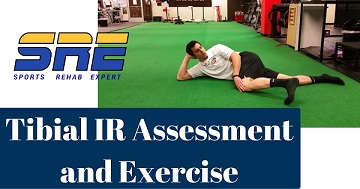
We have talked a lot about the importance of tibial rotation many times before on SRE. This is a big summary on what to do and what we use at SRE most often....keep reading
- Elite PT Blog - Landmine Front Squat to Press

Joe Heiler PT and Nick Lucius SPT The landmine squat to press is one of those exercises that can be used to really stress the entire system without having to utilize a lot of loading so it fits in nicely in higher level rehab and during the training process....keep reading
- SportsRehabExpert.com Presents: Lee Burton from Functional Movement Systems
In this interview Lee answers some of the frequently asked questions about chops and lifts such as when they should be used and which stance is best, why they are so beneficial for motor control training of the pelvis and core, as well as how to prevent athletes from using a high threshold strategy to compensate through the movements. Lee also answers some of the most common questions on the site concerning technique and cuing in the half and tall kneeling positions as well as in the three standing stance variations....keep reading
- 5 Mobility Issues Preventing a Consistent Release Point
Mike Reinold PT, DPT, SCS, ATC, CSCS Most people know that one of the keys to successful baseball pitching is a consistent release point. This is a point that is driven home by coaches all the time. Most people focus on your arm slot, for good reason. Many times inconsistency in your arm slot can be the major cause of poor biomechanics and difficulty repeating your delivery. I see this a lot in young baseball pitchers that are trying to tweak their mechanics and pitchers that may have discomfort in their shoulder or elbow and are trying to take some pressure off the sore area. However, the act of throwing a baseball is a sequence of kinetic chain events that ultimately lead to your release point. There are several factors with your lower body and core that may be altering your arm slot and leading to an inconsistent release point without you even realizing....keep reading
- Exercise of the Week
Band Assisted Nordic Hamstring

Andy Barker PT I have written previously on sportsrehabexpert.com about my love for the Nordic hamstring exercise in both training and rehab, providing it is done correctly. Most athletes cannot complete them correctly, often able to complete the exercise but with major compensatory patterns e.g. increased lumbar lordosis. I have found the use of resistance bands the happy medium between a traditionally hard exercise like the Nordic and correct technique....keep reading
- Glute-Ham Raise with Lumbar Correction
Joe Heiler PT, CSCS The glute-ham raise has always been one of my favorite exercises, but what I've realized is that most people are going to rely too much on their spinal erectors to complete the movement at the expense of the glutes and hamstrings. Over the past couple summers I've worked with numerous athletes with sore backs from performing this movement, or they just felt this movement was supposed to work their backs because this is where they feel it the most.......keep reading
Displaying Matches 961 thru 980 of 1468 Found FIRSTBACK NEXTLAST