

Most Popular Articles on this site
Reader Favorites
The list shows the most widely read articles on this site.
- Clinical Pearl - Instant Functional Change

Edo Zylstra, PT, DPT, MS, OCS, IMSp KinetaCore has had a great relationship with Physio's working in professional sports. I recently trained two PT/ATC's from the NFL in a condensed shortened advanced Functional Therapeutics course. Our goal was to evaluate and treat our functional movement in an assessment paradigm associated with one metric for return to sport -- the Functional Movement Screen. (Remember this is just one piece of the return to full athletic activity.)...keep reading
- The Myth of Neutral Spine
Mike Robertson Neutral spine is a myth. Or at least, the way we currently have this concept burned into our brains is at least a little flawed. Let me explain… When you set someone up to squat or deadlift effectively, there is most definitely a "neutral" position you want them in. I believe this is the optimal position, regardless of whether you're training for health and longevity or maximal performance. If you want a quick primer on what a neutral spinal alignment looks like, here goes....keep reading
- 5 Reasons to Use Speed Deadlifts in your Strength Training Programs
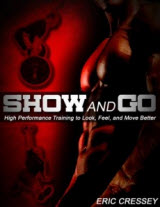
Eric Cressey When my first book was published back in 2008, a lot of people were surprised that I included speed deadlifts, either because they felt too easy, or because they didn't think that deadlifting that wasn't "heavy" couldn't be productive. Interestingly, when their deadlifts invariably shot up after completing the four-month program, nobody was questioning their inclusion. With that in mind, I thought I'd use today's article to outline my top five reasons for including speed deadlifts in one's strength training program....keep reading
- 5 Ways Breathing Affects Sports Performance
Kevin Neeld MS, CSCS, LMT Being a strength coach and a manual therapist has given me a different perspective on how important it truly is to assess athletes for structural and functional limitations and address them before they become serious injuries and surgeries. Exercises that revolve around optimizing breathing patterns have become a big piece of that equation for me over the last few years. Despite being a "soft" training modality, these strategies can have a significant impact on sport performance. Below are 5 major ways that breathing can affect sport....keep reading
- 'No Moving Parts' by Gray Cook/Reviewing the 'Exploring Functional Movement' DVD
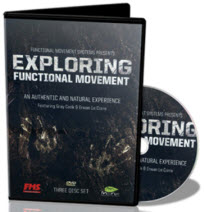
I've been planning on getting this review up, and then Gray just wrote this interesting article titled No Moving Parts so figured I'd find a way to work them in together. I like the idea of 'no parts, only patterns', and how he applies it to fitness. It is very much like the philosophy behind the Exploring Functional Movement DVD and MovNat. Some very cool movement progressions on that DVD, and I also really liked how they correlated many of the MovNat movements to corrections for the FMS. Very similar to what Gray and co. did teaming up with Pavel and Brett Jones to develop the CK-FMS....keep reading
- Manual Therapy Technique of the Week - Adductor Canal Release

Andy Barker PT I think we are pretty good at treating both medial hamstring and adductor related symptoms and using the appropriate manual therapy techniques as appropriate. More recently I have been having some success with both medial hamstring and adductor related symptoms by working between the interface of the medial hamstrings (semitendinosus and semimembranosus) and the long adductors (mainly adductor magnus and longus)....keep reading
- 5 Things to Look for in Runners
Erson Religioso III DPT, MS, MTC, CertMDT, CFC, CSCS, FAAOMPT Running is one sport that arguable needs more symmetry than most. I tell my runners it's because you're doing the same thing over and over for 1000s of steps until you stop! Here are 5 Things I learned to look for in the past few years in runners....keep reading
- Gray Cook Video - Sequence of Core Firing
I wanted to post this video to help answer some questions following Dr. Kiesel's interview from last week. Lots of talk about stability/motor control, and how to tap into the CNS with corrective exercise. This is a great video from Gray (via Laree Draper) from their Perform Better pre-con last summer. Gray is talking about FMS corrections in the video but as always is staying true to the neurodevelopmental progressions, the importance of taking on asymmetries, mobility before stability, and also a nice explanation contrasting stability vs. strength....keep reading
- Technique: Front Foot Elevated Split Squat
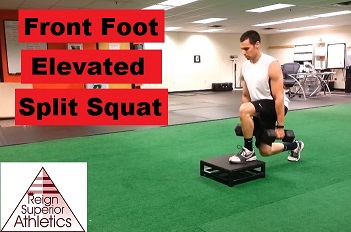
The front foot elevated split squat is an advancement of your typical split squat. These are the major tips you want to focus in on....keep reading
- Audio Interview with Anthony Renna

Anthony Renna CSCS, USAW is the owner of Five Iron Fitness in White Plains, NY and the man behind the Strength Coach Podcasts. Anthony is one of the best in the business when it comes to training golfers, and is a certified golf fitness instructor through Titleist. In this interview, Anthony discusses his screening process, injury prevention, training for performance, the Titleist program, and some great marketing tips for performance coaches and therapists alike....keep reading
- Motivation vs. Inspiration

Andy Barker PT Getting those we work with to 'buy in' to what we want them to do during both rehabilitation and training settings is often half the battle as we try to attain the intended goals of their programme. I attempt in this article to discuss some of the main concepts I believe to be important in trying to achieve this 'buy in,' in particular how this relates to both motivation and inspiration....keep reading
- Exercise of the Week - Deep Overhead Squat with Upper Extremity RNT
Joe Heiler PT In this week's edition of the 'exercise of the week' I'm featuring one of my favorite moves for creating stability through the trunk and upper extremities while requiring max mobility through the lower extremities - the deep overhead squat with upper extremity RNT. If I can restore shoulder and hip mobility then this is one of my go-to moves to work on re-training motor control in these areas plus it's a great corrective for the squat pattern itself....keep reading
- Introduction to the Chop and Lift

Gray Cook PT, OCS, CSCS Chopping and lifting is based on PNF (proprioceptive neuromuscular facilitation) patterns that are spiral and diagonal. When two hands are involved together on a stick, bar, or rope, in the same direction, crossing the mid-line of the body, in a downward or upward movement, it is called a chop or lift. The independent hand exercise is simply called D1 or D2 patterning, the direction of movement is named by flexion (upward) or extension (downward). These are advanced movements based on patterns used in the physical therapy profession....keep reading
- Lumbar Stabilization Programs: Ground Based Anti-Extension
Joe Heiler PT Lumbar stabilization programs have been around for a long time now, but are they really doing what they say they are? Stabilization, to me, means 'no movement' or 'resisting movement'. So maintaining control of the trunk with movements through the shoulders and hips would fit that basic definition. In this series, I'll present some basic lumbar stabilization exercises that combine the principles of Shirley Sahrmann and Mark Comerford, plus a bit of PRI postural correction and breathing work thrown in for good measure....keep reading
- Cook-ing the Turkish Get-Up - Speed Bump Part I
Gray Cook and Dr. Mark Cheng team up to discuss how the Turkish Get-Up can be used to determine and correct movement pattern dysfunctions. The Turkish Get-up is a functional exercise that can help restore movement patterns and build strength. The half Get-Up, discussed in this episode, can be incorporated with neck and shoulder rotations, which require total body engagement. Learning this first part of the Get-Up places a high priority on breathing, as opposed to powering through the movement....keep reading
- Athletes' - Performance Rehab Specialist Mentorship Part II

I never knew I could max out the text and number of videos on a page, but I just did. Therefore, on to Part II of the Athletes' Performance Rehab Specialist Mentorship Program. This will include days 4 and 5 as well as a wrap of the week including some topics we touched on but didn't go too much in depth. This thing could probably go 4 weeks and you'd still never get to it all, but this was a great start....keep reading
- Latissimus: The Secret Player

Mike Cantrell from the Postural Restoration Institute will be on for an interview in the next couple weeks covering the Myokinematics course and answering some frequently asked questions. I'm really looking forward to that so in the meantime I wanted to post an article that Mike wrote on the influence of the latissimus dorsi in all three planes of movement plus some PRI based techniques to inhibit that lat during corrective exercises. Enjoy!...keep reading
- Lateral Elbow Pain Treatment

Lateral Epicondylitis, commonly known as tennis elbow-, is one of the most common overuse injuries. There is poor blood supply to the musculotendinous region of the forearm extensors, often resulting in a decreased ability to heal that area following repetitive trauma. Despite the fact that it is commonly referred to as epicondylitis- with inflammation as a component, Nirschl reported in the Clinical Journal of Sports Medicine that it is actually a degeneration of the common extensor tendon with poor collagen alignment....keep reading
- Exercise of the Week - Bear Crawl Variations
Joe Heiler PT, CSCS Here's a classic exercise with a new twist. I've used these variations in our strength and conditioning programs, and also with many of our higher level patients with great results. There are a number of benefits to performing these variations from stability to creating better movement patterns......keep reading
Displaying Matches 941 thru 960 of 1468 Found FIRSTBACK NEXTLAST